● In short
- "Just a wrapper?" is shorthand for five concerns: defensibility, data, unit economics, dependence on one model provider and evidence that the product works.
- Prompts are not a moat. Unique data, deep integration into the customer's workflow and distribution are.
- Being a wrapper is fine. What matters is what you've built around the model that a competitor can't replicate in a month.
"Is it just a wrapper?" Build an AI startup, go out to raise, and you'll hear this. Usually before you've even shared your screen.
It's a fair question, and a slightly lazy one. Most AI products call someone else's model through an API, so in the literal sense almost everything is a wrapper. What the investor actually wants to know is whether the business survives the model getting cheaper, better and available to everyone. Take a closer look at the product, and the one question splits into five.
Since 2022 our studio has delivered 97 projects, most of them built on top of third-party models. The same five questions are the ones we ask ourselves before a build starts – so here is what a good answer to each one looks like.
Why the question comes so fast
Two years ago a working LLM demo was impressive on its own. Today anyone can get one running over a weekend, and investors have seen hundreds of them. Plenty of the companies behind those demos disappeared the day a model provider shipped the same feature in a release note.
So "wrapper" is less an accusation than a filter. It means: show me the part that's yours.
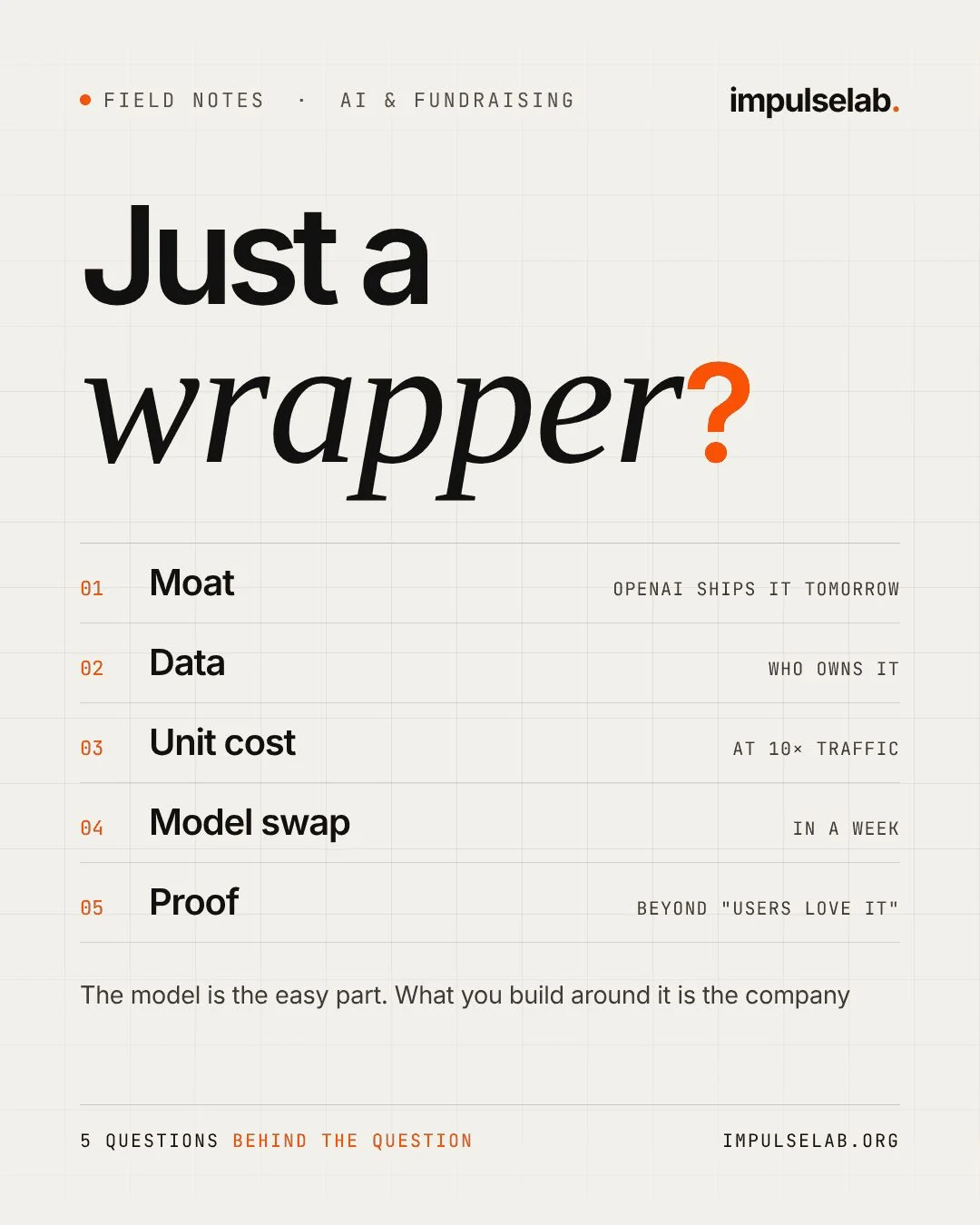
1. OpenAI ships it tomorrow. What now?
This is the moat question. If the core of the product is a clever prompt and a good interface, the honest answer is uncomfortable: a model provider or a well-funded competitor can reproduce it quickly, and the prompt itself will leak the first time someone asks the model the right question.
Prompts are not a moat, I'm afraid. What holds up:
- Unique data. Data the model can't see anywhere else – from your customers, your operations, your own labeling.
- Deep integration. Being wired into the customer's CRM, documents, approvals and daily routine. Once the product sits inside a working process, replacing it means rebuilding that process, not switching an API key.
- Distribution. A channel, a partnership or an audience that reaches customers more cheaply than anyone else can.
A good answer names which of these you have today and which you're building. Not all three – but at least one that's real.
2. Whose data is it?
The follow-up to the moat question. Investors want to know whether the data you depend on is yours to use, whether customers can take it with them, and whether it becomes more valuable over time.
The best answer, in my view: every new user makes the product better, and this is difficult to replicate. User corrections flow back into evals and fine-tuning, edge cases become test sets, and the product handles the next customer's requests a little better than the last one's. A competitor starting today can copy the interface. It can't copy two years of that loop.
Weaker answers are "we use public data" or a vague reply about consent and storage. Sometimes the customer has to own everything and nothing can be reused – that's a legitimate setup, but then the moat has to come from integration or distribution, and it's better to say so up front.
3. What does one operation cost at 10× traffic?
Unit economics are where wrappers most often break. I have seen demos that look great for 100 users and burn money at 10,000. Long context windows, chains of several model calls, retries and the most expensive model used for every step add up quickly – and in a demo nobody counts tokens.
A convincing answer covers:
- the cost of one operation today – one document, one conversation, one generated card – and what it's made of;
- what that cost looks like at ten times the volume, with real usage patterns rather than an average user;
- what you've done to bring it down: caching, smaller models for simple steps, batching, shorter context;
- gross margin per customer at the prices you charge now.
If the cost per operation falls as you grow, that's a strong signal. If it doesn't, the investor will do the math before you reach the next slide.
4. Can you replace the model in a week?
Your provider raises prices tomorrow, retires the model your prompts were tuned for, or changes its terms. If your margin disappears overnight, investors will notice – and they'd rather find out how exposed you are before they invest than after.
Two things help you get past that:
- An abstraction layer. The product talks to models through one interface of your own, so changing a provider is a configuration change and a test run, not a rewrite.
- Your own evals. A set of real cases with expected answers that runs automatically against any model. Without it, "we can switch" is a hope. With it, you can show the numbers for an alternative model within a day.
The second matters more. Most teams can technically call a different API in an afternoon. Few can say with confidence that the product still works afterwards.
5. How do you make sure that it works?
The answer "users love it" will not work here. Neither will a few testimonials or a great live demo: a demo shows the best case, and investors are asking about the typical one and the worst one.
What they want to see:
- Accuracy numbers on a fixed test set, tracked over time and across model versions.
- What happens when it gets things wrong. How errors are caught, how often they happen and what one costs the customer.
- A human in the loop when money is at stake. Payments, contracts, anything irreversible – a person approves before it happens, and the product is designed around that review rather than hiding it.
- A business number. Hours saved, conversion, cost per case – the thing the customer actually pays for. We agree on that number before every build; more in where AI actually pays back.
Being a wrapper is fine
Many successful products started as a layer on top of someone else's platform. Being built on another company's model isn't the problem – being nothing more than that is.
The model is the easy part. What you build around it is the company.
So the real question isn't whether you're a wrapper. It's this: what have you built around the model that your competitor cannot replicate in a month? The data loop, the integrations, the unit economics, the evals, the process that catches mistakes. That's what investors are trying to find out in those first five minutes.
Before the next pitch
Go through the five questions with your team and write down each answer in two sentences. Wherever the answer comes out vague, that's the slide that will draw the hardest questions – and usually the part of the product worth strengthening first.
Stress-testing these answers before an investor does is a big part of my work as a fractional CTO. If you're preparing to raise soon, get in touch
Case · Mobile · NLP
Keemoji
The model inside the product, not a layer on top: emotion recognition built into the iOS and Android keyboards. Company valuation grew from $20M to $200M+