● In short
- Voice is the right channel when your audience works with their hands and answers calls, not messages.
- The script matters more than the voice: short turns, one question at a time, an easy way out.
- The value is in call analysis — ranking leads so people only talk to the interested ones.
Agricultural trading has a contact problem. Organizers need to reach a large number of farms to find who has a crop to sell, how much, and when. Doing that by phone is slow: most calls go unanswered or end in “not now”, and an organizer can only make so many a day. Doing it online doesn't work because the audience isn't there. A voice AI robot fits exactly in between.
Why voice, and not a chatbot
Every channel decision should start with how the audience already communicates. For people who spend their day in a field or a cab, the phone is the default. They answer calls; they ignore links. A chatbot would have been easier to build and would have reached almost nobody. The rule generalises: logistics drivers, field technicians, construction crews and many small business owners are voice-first audiences.
Design the conversation, not the voice
Teams new to voice AI spend a lot of time choosing a synthetic voice. It matters less than they think. What matters is the shape of the conversation:
- Say who's calling and why in the first sentence. People hang up on calls that sound like a pitch before they know what it's about.
- One question per turn. “Do you have wheat to sell this season?” works. “Could you tell me what crops, volumes and timing you have?” doesn't.
- Expect interruptions. The robot has to stop talking the moment the person starts, and pick the conversation up from what they said.
- Handle the real answers. “Call my son”, “I'm driving”, “we sold everything last week” — each of these needs a sensible next step, not a retry of the script.
- Make it easy to say no. A polite exit and a promise not to call again builds more goodwill than any clever retention line.
Volume is cheap for a robot. Attention is expensive for a person — so spend the robot's time to save the person's.
The real product is call analysis
Making thousands of calls is the easy part. The value is in what happens afterwards. Every conversation is transcribed and analysed: Is there a product? What volume and timing? How interested did the person sound? Did they ask for a callback? The organizer gets a ranked list rather than a pile of recordings, and spends their day talking only to people who are ready to talk.
That is how one organizer can be backed by up to 30,000 calls a day without the job turning into listening to robots.
Noise, accents and bad connections
Field audio is hard: tractors, wind, weak mobile coverage, regional accents and domain vocabulary that general speech models have rarely heard. What helps most:
- Testing on real call recordings from the target region before launch, not on studio samples.
- A vocabulary of crops, units and local terms that the recognition and the analysis both use.
- Confirming key facts back to the person — “so that's about two hundred tonnes, ready in September?” — instead of trusting a single recognition pass.
How to tell if the robot works
Call volume is a vanity number. The metrics that decide whether a voice robot is worth running are further down the funnel:
- Connection rate: how many calls reach a person rather than voicemail or a busy line — this depends a lot on when you call.
- Completed conversations: how many people stay on the line long enough to answer the key questions.
- Lead quality: of the leads the analysis ranks at the top, how many turn into a real conversation with the organizer — and of the ones it ranks at the bottom, how many would a human have wanted?
- Organizer time per deal: the number that pays for everything else.
We review a sample of recordings every week with the client's team. Listening to twenty real calls tells you more about where the script breaks than any dashboard.
Respect the people on the other end
Automated calling is regulated in most places and resented almost everywhere when done badly. We call at sensible hours, identify the call as automated where required, honour opt-outs immediately and keep call volumes per number low. A voice robot that annoys its audience burns the very channel it depends on.
Is voice right for you?
If your team spends its days dialling lists where most calls lead nowhere, and your audience is more likely to answer a phone than an email, a voice robot with good call analysis can change the economics of that work. Start with one script, one region and a few hundred calls, and compare the leads it ranks highest with what your best caller would have chosen.
Case · Agriculture · Voice AI
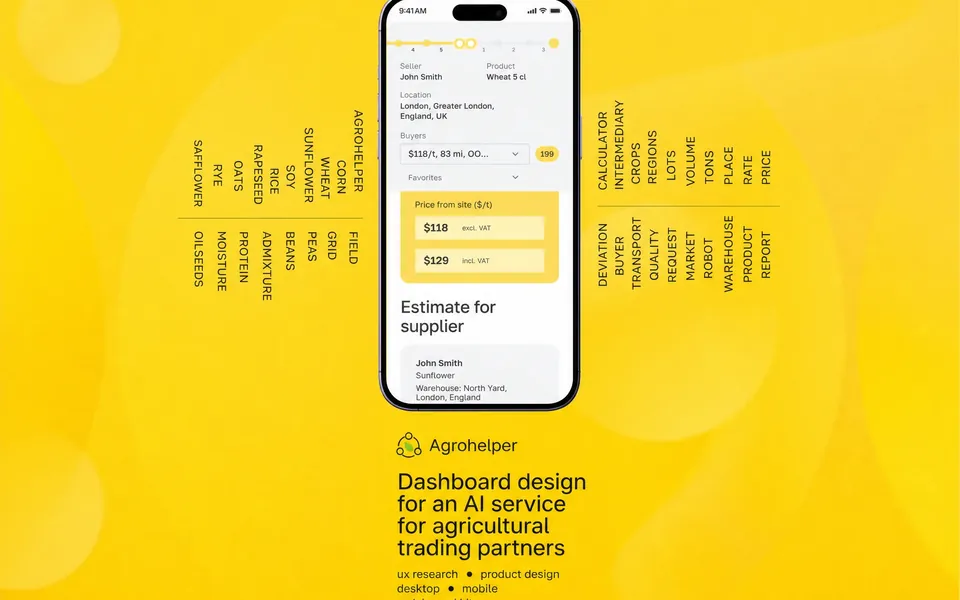
Agrohelper
A voice AI robot calls farmers and prioritizes leads: up to 30,000 calls per organizer a day